Local console
Your dashboard runs locally
Novence has no hosted control panel. Agents generate a local account console from the API — plan, quotas, projects, and billing — without ever putting your nv_ key in the browser.
What it is
The “dashboard” is an HTML file — typically novence-console.html — written from GET /v1/account/console-kit. The core deploy loop never requires it. Use it when you want a visual board for quotas and projects. Details and curls also live in /docs#console.
Account usage
Bars for storage, deploys, check minutes, custom domains, form submissions, and bandwidth against your plan caps. Click a project for cookieless traffic (pageviews, 404s, top pages).
Projects
List owned and shared projects with live URLs, deploy status, and your role.
Members
Invite collaborators on Pro/Scale (5/20 seats per project). Invites land on /invite. Each member gets their own project-scoped nv_ key — never share the owner's.
Billing actions
View plans lists Pro and Scale and starts Stripe Checkout. Manage billing opens the Customer Portal for an existing subscription.
How to access it
Step 01 · Run the CLI
npx novence dashboard (alias novence console). It fetches the kit, writes the file outside your project, serves it on the first free 127.0.0.1 port from 8765, and opens the browser. Ctrl+C stops it and deletes the file.
Step 02 · Or fetch the kit
GET https://api.novence.ai/v1/account/console-kit with your nv_ key or a mgmt_ token from email OTP — or MCP get_account_console_kit. With nv_, session.token is a fresh 30-minute mgmt_ token. Never put nv_ in the HTML.
Step 03 · Write & serve locally
Write novence-console.html from the template as-is into an empty folder, replacing the /*NOVENCE_INJECT*/ marker. Pick a free port (never assume 8765), serve on http://127.0.0.1 — not file:// — and open that port.
Humans without the key: npx novence dashboard signs in with an email code, or use Switch account in an open console (POST /v1/account/sessions/request + …/verify). Security notes: /security.
What’s available
- Account board: email, plan (Free / Pro / Scale), verification, storage, deploys, check minutes, domains, form submissions, bandwidth
- Projects: name, live URL, deploy status — click for project-level usage against the same plan quotas
- Actions: Refresh snapshot, View plans, Manage billing, Switch account (email code), Log out. Quotas alias:
GET /v1/billing/quotas
What it looks like
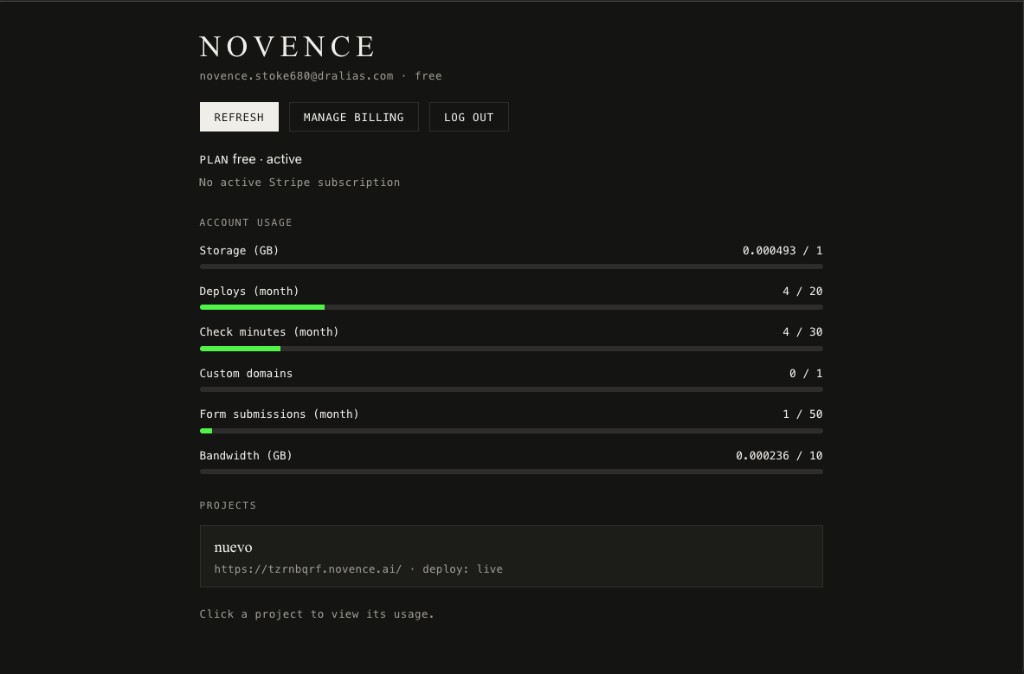
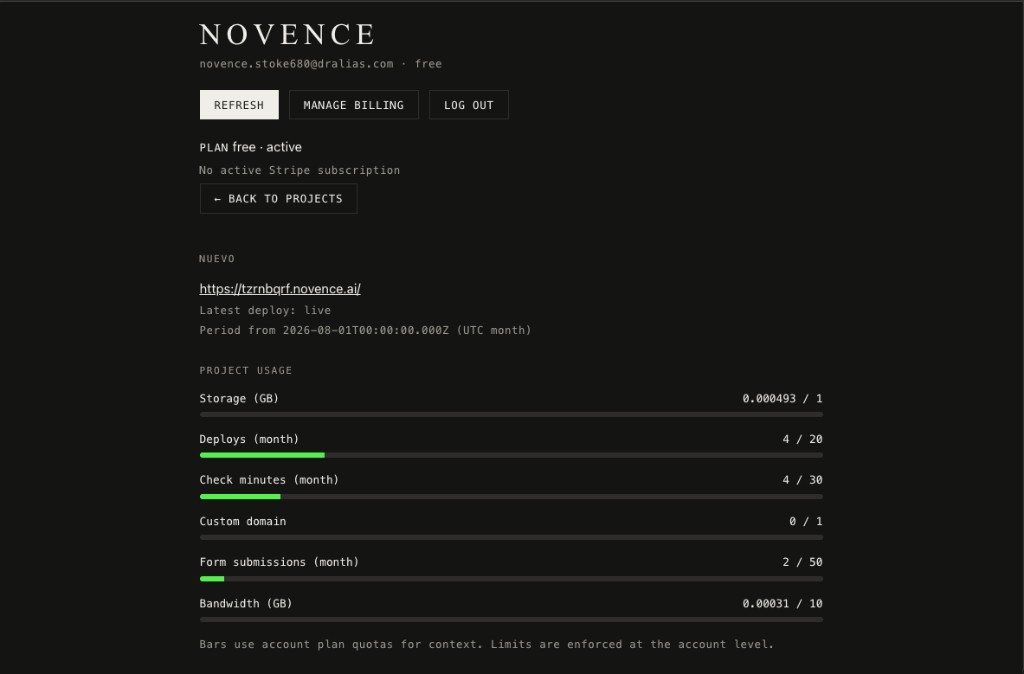
Dashboard FAQ
Is there a hosted Novence dashboard in the browser?
No. By design there is no login.novence.ai console. The account UI is a local HTML file your agent (or you) generates from GET /v1/account/console-kit and serves on http://127.0.0.1.
How do I open the dashboard?
Run npx novence dashboard. It uses your saved key (or signs you in with an email code), serves the console on the first free 127.0.0.1 port from 8765, and opens that exact URL. Agents can also call GET /v1/account/console-kit and serve the htmlTemplate themselves. Do not open file://.
What can I see in the dashboard?
Plan and verification status, account-wide quotas vs usage, projects (owned and shared), members, Refresh, View plans, Manage billing, Switch account, and Log out.
Can humans use it without an agent?
Yes. Run npx novence dashboard and sign in with an email code, or use Switch account inside an existing console. Without a shell: POST /v1/account/sessions/request, then …/sessions/verify for a mgmt_ token, then GET /v1/account/console-kit with that token.
The console shows an old account or an expired session. Why?
An earlier server is probably still holding port 8765 and serving a stale file. npx novence dashboard picks a free port automatically. If you serve it by hand, check the port first (lsof -iTCP:8765 -sTCP:LISTEN) and use the next free one.
Generate your console
Run npx novence dashboard. Agents can also use console-kit directly.